Beyond the session: Why parents are essential for success
Often, the therapist is seen as being the ‘expert’. The therapeutic work is seen as happening entirely within the therapy session, and changes are expected to follow afterwards. But this perspective overlooks a crucial element for lasting success: the parent or caregiver and what happens between therapy sessions. Therapy is not a magical fix, nor is it a one-hour-a-week event. Instead, it’s a collaborative process where the parents’ engagement in the therapy session is crucial to success, and what happens during the session is just the start of the process of working towards achieving goals.
In this blog post, we’ll explore why your engagement is not just helpful but truly essential for your child’s success.
Meaningful goals
Before starting therapy, therapists usually set goals for the child in order to have a clear idea of what therapy sessions should focus on. Involving the child, as well as the family, in goal setting is essential in order to choose goals that are important and meaningful for the child and family. Meaningful goals lead to meaningful outcomes. When parents and caregivers are involved in goal setting, therapy is focused on what is important to the child and family.
Time
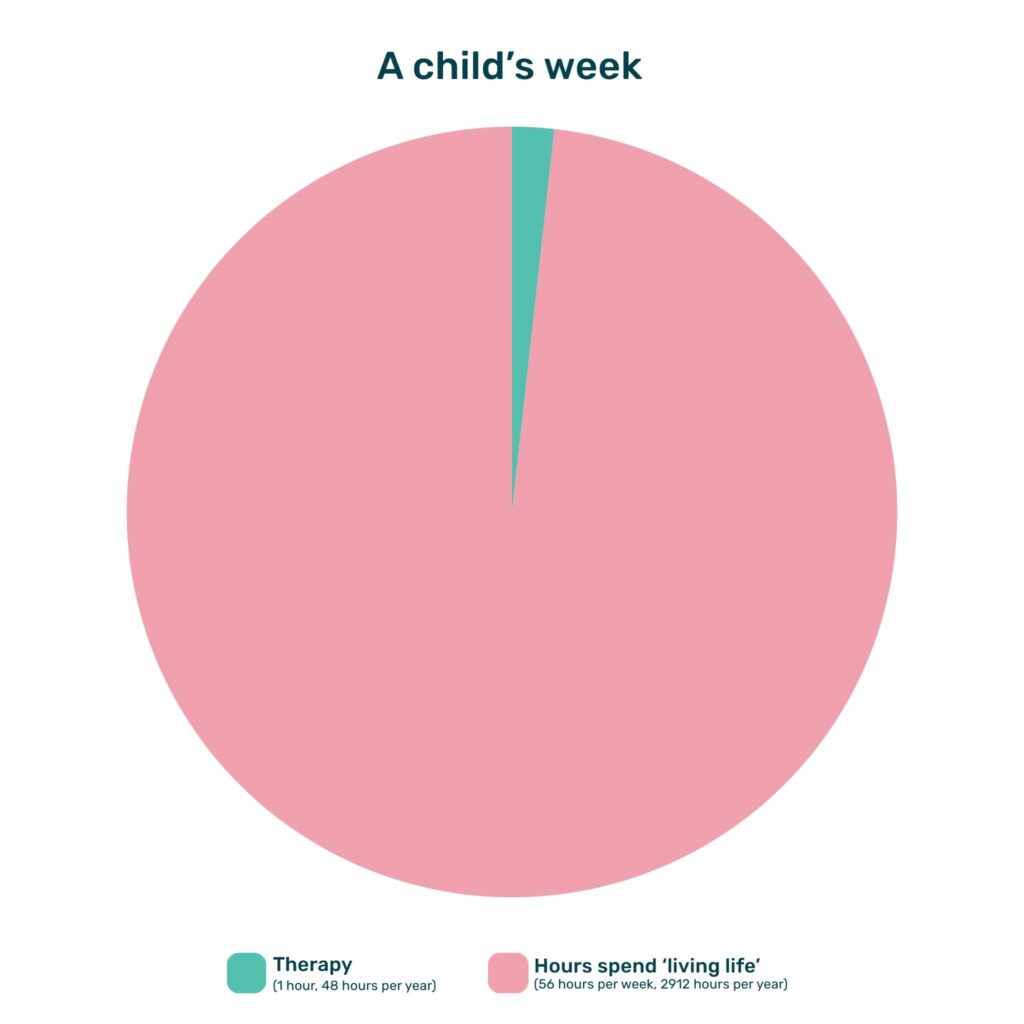
The amount of time a child spends in therapy sessions is tiny compared to the time spent living: playing, eating, learning, and spending time with family and friends. Even if your child had an hour of therapy weekly, that would be only 48 hours per year, whereas they have roughly 56 hours per week (awake) outside of therapy, which is a staggering 2912 hours per year! Therapy sessions make up such a small portion of a child’s week, so progress relies heavily on what happens outside of sessions.
Strategies work best when implemented into daily routines in everyday settings
Involving parents and caregivers in therapy is integral to children achieving their goals because children learn and develop most within their everyday environments and relationships. Research has shown that practicing skills in the child’s regular routines and activities has more impact than a program implemented once a week or more frequently by an early intervention professional in a clinical setting (Kemp, 2020, pp. 164-165). Children are more likely to use new skills across different settings when caregivers reinforce them in real-life situations. When caregivers are involved, strategies practised in therapy can carry over into the child’s everyday routines — where meaningful learning and skill-building occur.
Relationship
Involving parents and caregivers in therapy is integral to children achieving their goals because children learn and develop most within their everyday environments and relationships. Research has shown that practicing skills in the child’s regular routines and activities has more impact than a program implemented once a week or more frequently by an early intervention professional in a clinical setting (Kemp, 2020, pp. 164-165). Children are more likely to use new skills across different settings when caregivers reinforce them in real-life situations. When caregivers are involved, strategies practised in therapy can carry over into the child’s everyday routines — where meaningful learning and skill-building occur.
Reference
Dunst, C. J. , Trivette, C and Hamby, D (2007) Meta-analysis of family-centred help giving practices research. Families of Children with Developmental Disabilities. 13:370-378.
Kemp, C. (2020). Research informing practice in early childhood intervention. Infants & Young
Children, 33(3), 163-172. [O] https://doi.org/10.1097/IYC.0000000000000168
About the author
Eva is the Early Childhood Clinical Excellence Lead at KEO. She has worked as a transdisciplinary Key Worker and paediatric physiotherapist since 2009 and is passionate about supporting families to achieve the best outcomes for their children. In her role at KEO Care, Eva trains and supports Key Workers as they in turn support children and families.